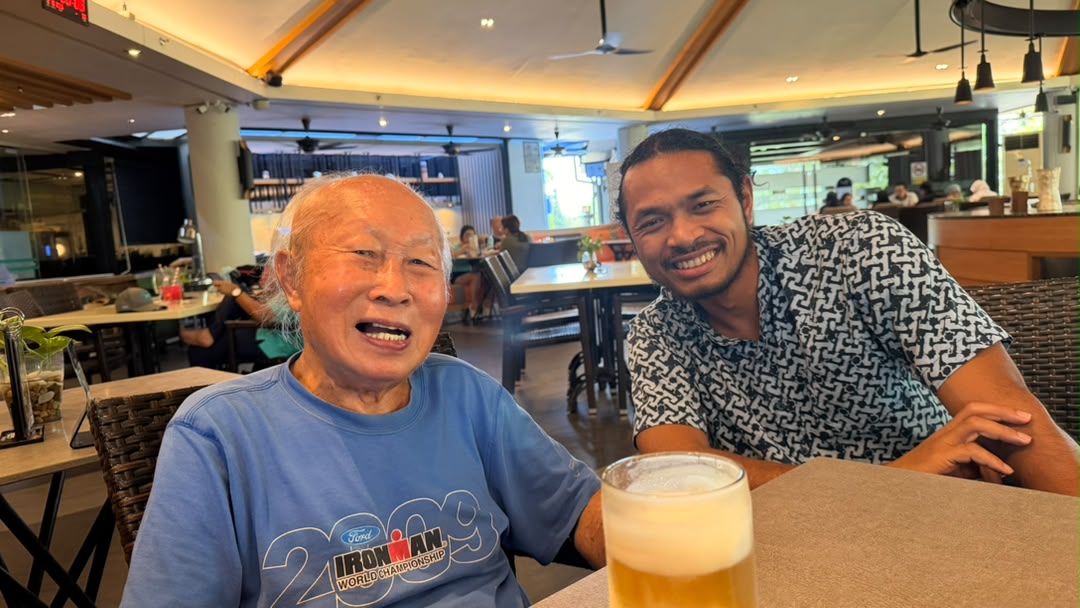
On Friday, 2nd October 2026, I had the chance to meet Uncle Yee, a popular Ironman figure in Malaysia. I’d heard of him for years, since many of my friends are Ironman athletes. This time, Pui Yan, who is related to Uncle Yee, introduced us.
Uncle Yee's Ironman journey started in his 50s
Uncle Yee is a Malaysian triathlete who completed his first Ironman in Kona, Hawaii, in 1995, at age 58. His intense sporting journey began in his 50s, after his doctor advised him to become more active due to deteriorating health. From then on, he took up Ironman, never stopped, and went on to complete at least 16 full Ironman races and 37 half-Ironman races. In each Ironman, he swam 3.8 kilometres in the sea, cycled 180 kilometres, and ran 42 kilometres, all within 17 hours. This feat is no joke: he’s accomplished it 16 times, so it’s no surprise he was inducted into the Ironman Malaysia Hall of Fame in 2015.
 With Uncle Yee and Pui Yan, surrounded by the medals, photographs and newspaper clippings that tell the story of his remarkable sporting journey.
Spending an afternoon with him was an honour, as I got to understand where his power and strength come from. His Ironman achievements are simply by-products of the way he lives his life.
When his sister was born, his mother was alone and had to cut the umbilical cord by biting it herself. That incredible resilience shaped how she raised and provided for her family, and it deeply influenced Uncle Yee’s life. As he described, his mother was a pillar of their family and made him who he is today.
Uncle Yee has a strong passion for everything he does. After an hour of talking about his Ironman journey, I asked him about his work. He used to work at a gas company, and a picture on his wall shows him standing on top of a construction tower without a safety belt—a time when safety wasn’t emphasised. He said, “Before my staff goes up there, I need to do it first. A general, I must lead by example.” In the picture, the tower looked incredibly high. It’s wild to imagine climbing it without a safety belt, yet he showed that, as a true leader, he would never ask someone to do something he wouldn’t do himself.
Uncle Yee also shared his philosophy about money: “You have to value other people’s money like your own.” When he worked for a company abroad, he chose to stay at a simple hotel, and his bill was the lowest among his colleagues. Sometimes, his colleagues disliked this, as it challenged their mindset about spending the allowances they received while working overseas.
As our conversation continued, he shared more wisdom. He used to work overtime without complaining or asking for extra pay. Later, when opportunities arose, his boss promoted him, saying, “You deserve this job. It wasn’t your responsibility, but you self-studied and learned about it, so you earned the position. That’s what it means to deserve a job: you have to be qualified before you’re given the post.”
Listening to Uncle Yee, I began to see how much his mother, his working years, and the morals he carried through life shaped his story. Our parents have stories like these, too. We might know what they did for a living, but how much do we know about the people who shaped them, the difficult choices they made, or the hopes they once had? This is why we started KARANG: to give families the chance to hear and preserve those stories. The next time you sit down with your parents, ask them about a part of their life you’ve never heard before. Give them time to tell it.